
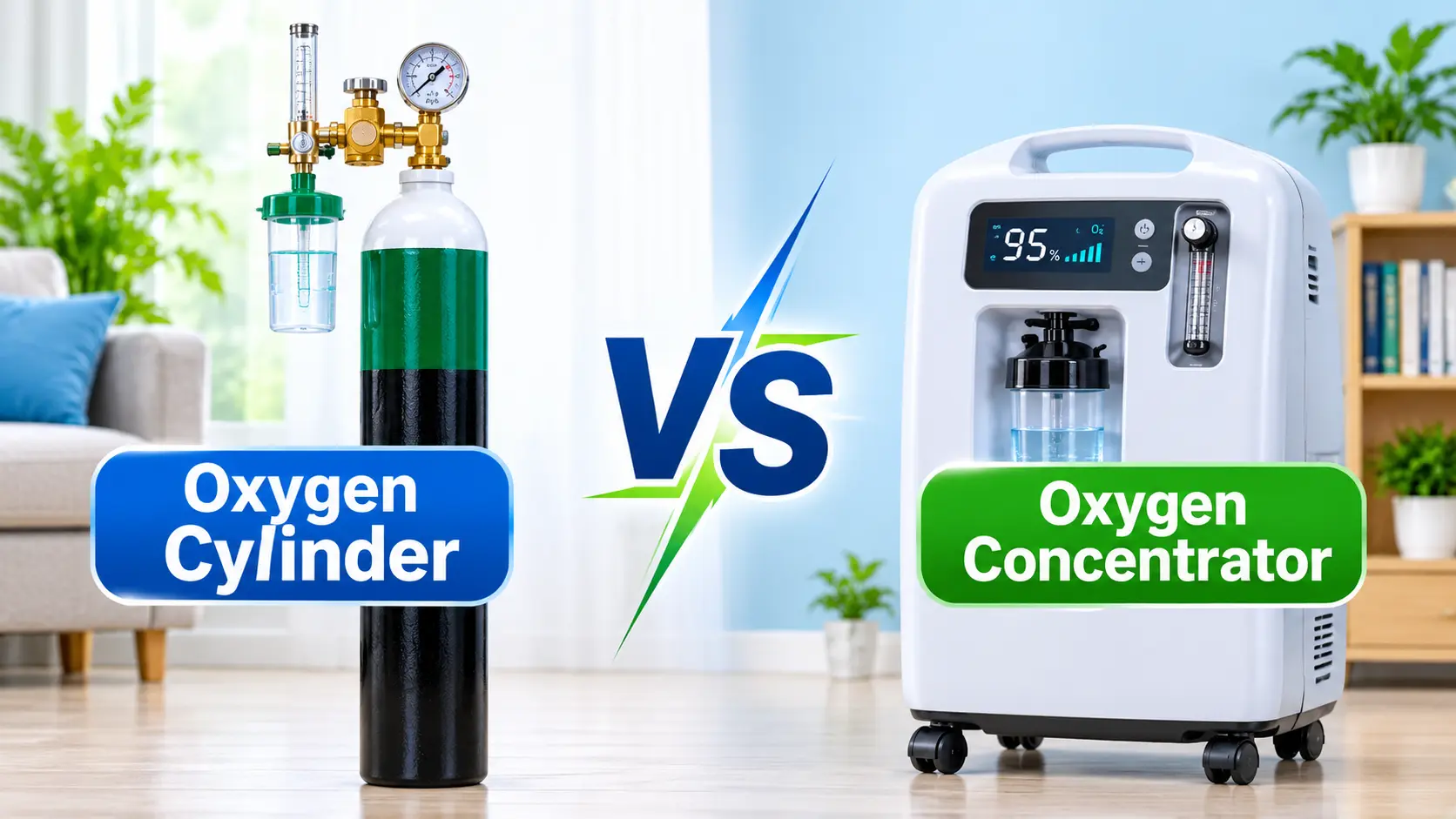
Oxygen Cylinder vs Oxygen Concentrator: Which Is Better for Home Use?
Quick answer: For daily, long-term home oxygen therapy, an oxygen concentrator is usually the better choice, because it makes oxygen from room air and needs no refills. An oxygen cylinder is better for emergencies, short-term use, and power cuts. Many families keep both: a concentrator for everyday use and a small cylinder as backup. Your doctor decides which one you need and at what flow rate.
Important: Oxygen is a medical treatment. Do not start oxygen, buy equipment, or change the flow rate without a doctor’s prescription.
Basics: What Are They and How Do They Work?
What Is an Oxygen Cylinder?
An oxygen cylinder is a metal container filled with pure medical oxygen under high pressure. It stores a fixed amount of gas. When the gas runs out, the cylinder must be refilled or replaced by a licensed supplier.
What Is an Oxygen Concentrator?
An oxygen concentrator is an electric machine that produces oxygen from the air in the room. It does not store a fixed amount of gas. As long as it has power, it keeps delivering oxygen.
How Does an Oxygen Cylinder Work?
A cylinder releases its stored oxygen through a regulator and flowmeter. First, the regulator lowers the high pressure to a safe level. Next, the flowmeter lets you set the flow in liters per minute. Finally, the oxygen travels through tubing to a nasal cannula or mask.
How Does an Oxygen Concentrator Work?
A concentrator pulls in room air, filters out most of the nitrogen, and delivers the concentrated oxygen through tubing. Room air contains about 21% oxygen. After this process, the machine typically delivers around 90–95% oxygen. You set the flow on the device, and it runs on electricity or a battery.
What Is the Difference Between an Oxygen Cylinder and an Oxygen Concentrator?
A cylinder stores oxygen, while a concentrator makes it. As a result, a cylinder runs out and needs refills, but a concentrator needs electricity instead. Cylinders are simple and work during power cuts. Concentrators suit daily use because the supply does not end.
Which Is Better for Home Use?
Which Is Better for Home Use: an Oxygen Cylinder or an Oxygen Concentrator?
For most patients who need oxygen every day, a concentrator is better. It gives a steady supply without refills and costs less over time. However, a cylinder is the better option when oxygen is needed only briefly, in an emergency, or when electricity is unreliable.
Which Is Better for Long-Term Home Oxygen Therapy?
A concentrator is better for long-term therapy. Patients on long-term oxygen may need it many hours a day, including during sleep. A concentrator can run continuously, so you avoid frequent refills and cylinder deliveries.
Which Is Better for Emergency Use?
A cylinder is better for emergencies. It works instantly without electricity and is easy to keep ready as backup. For this reason, hospitals, ambulances, and many households keep cylinders for sudden needs.
Which Is Better for COPD Patients?
For COPD patients who need daily oxygen, a concentrator is usually the main choice, with a cylinder kept as backup. However, too much oxygen can be harmful in COPD. Therefore, always use the flow rate your doctor prescribes, whichever device you choose.
Which Is Better for Elderly Patients at Home?
A concentrator is often easier for elderly patients. There is no valve to open, no pressure gauge to read, and no refill schedule. Still, a caregiver should help with setup, filter cleaning, and backup planning.
Can an Oxygen Concentrator Replace an Oxygen Cylinder?
For daily use, yes. A concentrator can replace a cylinder in most routine home therapy. However, it cannot replace a cylinder during a power cut unless you have a battery or generator. Some patients also need a higher flow than a home machine can provide, so check this with your doctor.
Should I Keep Both an Oxygen Cylinder and an Oxygen Concentrator at Home?
Yes, if you can, keeping both is the safest setup. Use the concentrator every day, and keep a filled cylinder with a regulator and flowmeter ready for power cuts and emergencies. Also, check the cylinder’s gauge regularly so it is never empty when needed.
Oxygen Cylinder vs Concentrator: Key Differences
| Feature | Oxygen Cylinder | Oxygen Concentrator |
|---|---|---|
| Oxygen source | Pre-filled compressed oxygen | Made from room air |
| Supply | Limited, needs refills | Continuous while powered |
| Electricity | Not needed | Needed (or battery) |
| Purity | About 99% or higher | About 90–95% |
| Upfront cost | Lower | Higher |
| Long-term cost | Rises with refills | Usually lower |
| Noise | Silent | Steady hum |
| Best for | Emergency, backup, short-term | Daily, long-term, sleep |
Which Gives Purer Oxygen: a Cylinder or a Concentrator?
A cylinder gives purer oxygen. Medical cylinders contain about 99% or more oxygen, while a concentrator usually delivers about 90–95%. For most home patients, this difference does not matter, because doctors prescribe concentrators when they are suitable.
Which Has a Higher Flow Rate?
Cylinders can usually deliver higher flow rates, but they empty faster at high flow. Most home concentrators provide about 1–5 liters per minute, and some models reach 10. Always check the machine’s maximum flow before buying.
Which Is Easier to Use at Home?
A concentrator is easier for daily use. You plug it in, set the flow, and start. In contrast, a cylinder needs careful valve handling, gauge checking, and timely refills.
Which Is More Portable?
Small cylinders are portable but heavy, and they run out quickly. Portable concentrators are lighter and battery-powered, so they suit travel and outings. However, they often give pulse-dose oxygen and may not meet high-flow needs.
Which Is Quieter?
A cylinder is completely silent. A concentrator makes a steady humming sound. Therefore, place it in a well-ventilated spot a little away from the bed, and use a longer tube instead of putting it next to your pillow.
Which Needs More Maintenance?
Both need care, but in different ways. A cylinder needs regular refills, valve and regulator checks, and humidifier cleaning. A concentrator needs filter cleaning as the manual advises, periodic servicing, and a stable power supply.
Which Lasts Longer?
A concentrator lasts longer in daily use, because it can run as long as it has power. A cylinder lasts only until its gas is used up. For example, a cylinder with about 1,500 liters of oxygen lasts roughly 12.5 hours at 2 liters per minute.
Cost Comparison
What Is the Cost of an Oxygen Cylinder vs an Oxygen Concentrator?
A cylinder costs less to buy, but you also pay for the regulator, flowmeter, refills, and sometimes a deposit. A concentrator costs more upfront, then adds electricity and servicing costs. Prices vary by brand, size, and city. [Add your local price range here.]
Which Is Cheaper in the Long Run?
A concentrator is usually cheaper in the long run for daily use. Repeated refills and deliveries add up quickly, and these costs do not apply to a concentrator. On the other hand, for occasional use, a cylinder is the cheaper option.
Is It Better to Buy or Rent an Oxygen Concentrator?
Rent for short-term needs, such as recovery after an illness, or to test a model first. Buy if your doctor expects long-term use. In both cases, ask about warranty, servicing, and replacement support before paying.
How Much Does It Cost to Refill an Oxygen Cylinder?
The refill cost depends on cylinder size, your city, and the supplier. Delivery charges may be extra. Ask your licensed supplier for a per-refill quote, and arrange a replacement before the current cylinder is empty.
Power Cuts and Electricity
Does an Oxygen Concentrator Work Without Electricity?
A standard home concentrator does not work without electricity. Portable models run on batteries, but only for a limited time. Therefore, keep a filled cylinder as backup, especially if power cuts are common in your area.
What Should You Do During a Power Cut If You Use a Concentrator?
- First, switch to your backup cylinder right away.
- Next, set the flow rate your doctor prescribed.
- Then, if you have a compatible battery, UPS, or generator, connect it to the concentrator.
- After that, call your oxygen supplier if the cut will last long.
- Finally, contact a doctor or emergency care if breathing worsens.
How Long Can an Oxygen Concentrator Run Continuously?
Most home concentrators are designed for continuous use, including 24 hours a day. However, models differ, so follow the manufacturer’s manual. Also, keep a backup cylinder in case the machine fails.
Safety
Which Is Safer for Home Use: an Oxygen Cylinder or an Oxygen Concentrator?
Both are safe when used correctly and under a doctor’s guidance. Many people find a concentrator easier and safer for daily use, because it has no high-pressure gas to handle. Nevertheless, a cylinder is just as safe if it is stored upright, secured, and kept away from fire.
What Are the Fire Risks of Oxygen Cylinders and Concentrators?
Oxygen makes fires burn hotter and faster. Therefore, both devices need strict fire safety. Keep them at least 5 feet (about 1.5 meters) from flames, stoves, heaters, and electrical sparks. Never smoke nearby, and never apply oil, grease, or petroleum jelly to the equipment.
Can I Use an Oxygen Concentrator or Cylinder Without a Prescription?
No. Oxygen is a medical treatment, and the wrong dose can be harmful. Always get a doctor’s prescription first. This is especially important if you plan to buy equipment online.
Who Should Choose Which?
Who Needs an Oxygen Concentrator at Home?
A concentrator suits people who need oxygen for many hours daily or during sleep. Examples include patients with COPD, pulmonary fibrosis, heart failure, or long-term lung damage. It also suits families who want to avoid frequent refills.
Who Needs an Oxygen Cylinder at Home?
A cylinder suits people who need oxygen for short periods or in emergencies. It also suits households with frequent power cuts, and it is the standard backup for concentrator users. In addition, it is useful when budget is limited.
Can You Sleep With an Oxygen Concentrator?
Yes, if your doctor recommends oxygen during sleep. A stationary concentrator is the most common choice for nights. Place it in a ventilated spot, keep the tubing from wrapping around the neck, and keep a backup cylinder nearby.
How Many Liters per Minute Does a Home Oxygen Concentrator Provide?
Most home concentrators provide about 1–5 liters per minute, and some models reach up to 10. The right setting is the one your doctor prescribes. Do not increase it on your own.
What Are the Disadvantages of an Oxygen Concentrator?
- Higher upfront cost
- Needs electricity or a battery
- Produces noise
- Slightly lower oxygen purity than a cylinder
- Needs filter cleaning and servicing
What Are the Disadvantages of an Oxygen Cylinder?
- Supply ends and needs refilling
- Heavy to move
- Repeated refill costs
- Needs careful storage and handling
- Not ideal for round-the-clock use
How to Choose Between an Oxygen Cylinder and an Oxygen Concentrator?
Start with your doctor’s prescription, then match it to your daily routine. If you need oxygen every day, choose a concentrator. If you need it occasionally or for emergencies, choose a cylinder. Additionally, think about power cuts, budget, and who will help you at home.
What Should I Check Before Buying an Oxygen Concentrator?
- Check that its flow range matches your prescription.
- Look at noise level and power use.
- Confirm warranty, servicing, and replacement support.
- Check for alarms, such as low oxygen or power failure.
- Ask about battery or backup options.
- Buy only from a reputable, licensed supplier.
What Is the Difference Between a Portable and a Stationary Oxygen Concentrator?
A stationary concentrator stays at home, is heavier, and is quieter and more durable for daily use. A portable concentrator is lighter, runs on batteries, and suits travel. However, portable models often deliver pulse-dose oxygen and may not cover high-flow needs.
Summary
Neither device wins in every situation. A concentrator is better for daily, long-term home therapy, while a cylinder is better for emergencies, power cuts, and short-term use. Therefore, the safest setup for many homes is a concentrator plus a backup cylinder. Above all, follow your doctor’s prescription, keep the equipment away from fire, and check your SpO₂ regularly
Frequently Asked Questions About Oxygen Cylinders and Concentrators
Which is better, an oxygen concentrator or an oxygen cylinder?
For daily, long-term use, an oxygen concentrator is usually better because it makes oxygen from room air and needs no refills. However, a cylinder is better for emergencies and power cuts. Therefore, many homes keep a concentrator for everyday therapy and a cylinder as backup. Your doctor decides the right choice.
Are oxygen concentrators as good as oxygen tanks?
For most daily home therapy, yes. A concentrator delivers about 90–95% oxygen, while a cylinder gives about 99% or more, but this gap rarely matters for prescribed home use. However, a concentrator needs electricity and may not meet very high flow needs. In those cases, a cylinder is still the safer backup.
What are the disadvantages of an oxygen concentrator?
The main disadvantages are a higher upfront cost, the need for electricity or a battery, and a steady humming noise. Also, it gives slightly lower oxygen purity than a cylinder and needs filter cleaning and servicing. Because of power cuts, keep a filled backup cylinder at home.
What is the best oxygen for home use?
The best option is the one your doctor prescribes for your condition. For most people who need oxygen daily, that is a stationary oxygen concentrator with a backup cylinder for power cuts. In addition, a portable concentrator suits travel. Never buy or start oxygen without a prescription.
